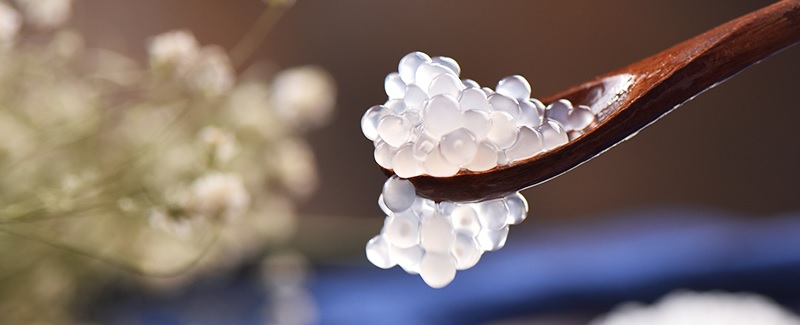
For short, Sago is tiny and translucid balls made of starch, with a delicate texture and mild flavor. As much as Tapioca Pearls, they are used in several Asian dishes.
Sago (/ˈseɪɡoʊ/) is a starch extracted from the pith, or spongy core tissue, of various tropical palm stems, especially those of Metroxylon sagu. It is a major staple food for the lowland peoples of New Guinea and the Maluku Islands, where it is called saksak, rabia and sagu. The largest supply of sago comes from Southeast Asia, particularly Indonesia and Malaysia. Large quantities of sago are sent to Europe and North America for cooking purposes. It is traditionally cooked and eaten in various forms, such as rolled into balls, mixed with boiling water to form a glue-like paste (papeda), or as a pancake.
Sago is often produced commercially in the form of “pearls” (small rounded starch aggregates, partly gelatinized by heating). Sago pearls can be boiled with water or milk and sugar to make a sweet sago pudding. Sago pearls are similar in appearance to the pearled starches of other origin, e.g. cassava starch (tapioca) and potato starch. They may be used interchangeably in some dishes, and tapioca pearls are often marketed as “sago”, since they are much cheaper to produce. Compared to tapioca pearls, real sago pearls are off-white, uneven in size, brittle and cook very quickly.
The name sago is also sometimes used for starch extracted from other sources, especially the sago cycad, Cycas revoluta. The sago cycad is also commonly known as the sago palm, although this is a misnomer as cycads are not palms. Extracting edible starch from the sago cycad requires special care due to the poisonous nature of cycads. Cycad sago is used for many of the same purposes as palm sago.
(Information extracted from Wikipedia)



 Hi Sweetie Tea & Treats